




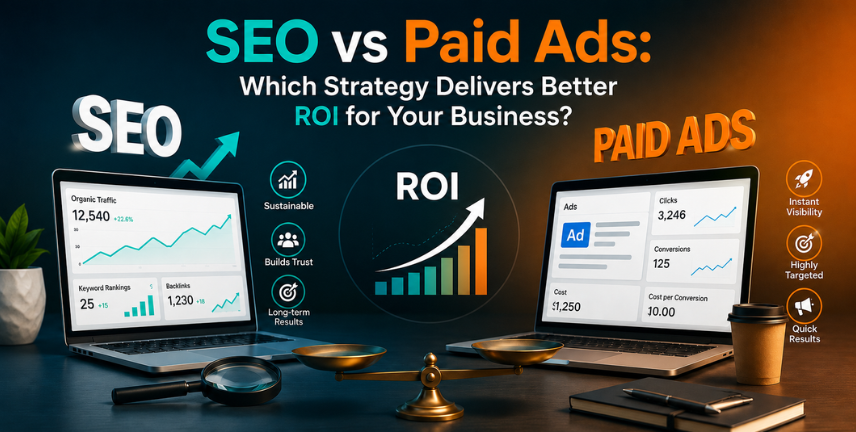
SEO vs Paid Ads: Which Strategy Delivers Better ROI for Your Business?
Choosing between SEO and paid advertising is one of the most important decisions businesses make when planning their digital marketing strategy. While SEO helps improve organic search rankings and delivers long-term traffic, paid ads generate instant visibility and qualified leads. Understanding the strengths, costs, and return on investment (ROI) of each approach can help businesses allocate their marketing budget more effectively. Whether your goal is to increase website traffic, generate leads, or boost online sales, combining SEO and paid advertising strategically can maximize results. This guide explains the key differences, benefits, and ROI of both marketing approaches.
SEO vs Paid Ads: Which Strategy Delivers Better ROI for Your Business?
In today's competitive digital landscape, businesses are constantly looking for the most effective ways to attract customers, generate leads, and increase revenue. Two of the most popular digital marketing strategies are Search Engine Optimization (SEO) and Paid Advertising (PPC). Both are powerful tools for driving website traffic, but they work in different ways and offer unique advantages.
The question many business owners ask is: Which strategy delivers better return on investment (ROI)? The answer depends on your business goals, budget, competition, and timeline. Understanding the strengths and limitations of SEO and paid advertising can help you make smarter marketing decisions and maximize your investment.
What Is SEO?
Search Engine Optimization (SEO) is the process of improving your website's visibility in organic search engine results. It involves optimizing website content, technical performance, user experience, keywords, and backlinks so search engines rank your pages higher for relevant searches.
Unlike paid advertising, SEO does not require paying for every website visitor. Instead, it focuses on building long-term authority and earning consistent organic traffic over time.
Benefits of SEO
-
Increases long-term organic website traffic.
-
Builds trust and credibility with potential customers.
-
Delivers sustainable lead generation.
-
Improves user experience and website performance.
-
Generates higher ROI over the long term.
-
Reduces dependence on paid advertising.
Although SEO requires patience, the results often continue long after the initial optimization work has been completed.
What Are Paid Ads?
Paid advertising, commonly known as Pay-Per-Click (PPC), allows businesses to display ads on search engines and social media platforms. Advertisers pay only when users click on their ads.
Platforms such as Google Ads, Facebook Ads, Instagram Ads, LinkedIn Ads, and Microsoft Advertising enable businesses to target audiences based on keywords, demographics, interests, locations, and online behavior.
Paid advertising delivers immediate visibility and is ideal for businesses looking for fast results.
Benefits of Paid Advertising
-
Generates immediate website traffic.
-
Provides instant visibility on search engines.
-
Highly targeted audience segmentation.
-
Easy to scale campaigns.
-
Ideal for promotions, product launches, and seasonal campaigns.
-
Detailed campaign performance tracking.
However, traffic stops as soon as the advertising budget ends, making PPC a short-term traffic solution unless campaigns continue running.
SEO vs Paid Ads: Key Differences
Speed of Results
Paid advertising provides immediate results. Once campaigns are launched, businesses can begin receiving website visitors and leads within hours.
SEO takes longer to produce measurable results. Depending on competition and website authority, it may take several months before significant improvements appear.
If your business needs quick leads or immediate sales, paid advertising offers a faster solution.
Cost Comparison
SEO requires investment in content creation, technical optimization, keyword research, and link building. While upfront costs can be significant, organic traffic becomes increasingly cost-effective over time.
Paid advertising requires continuous spending. Every click has a cost, and competitive industries often experience high cost-per-click (CPC) rates. Once campaigns stop, traffic disappears.
For businesses seeking sustainable growth, SEO generally delivers better long-term value.
Return on Investment (ROI)
ROI is one of the biggest differences between SEO and PPC.
SEO builds long-term digital assets. High-ranking pages can generate leads and website traffic for years with ongoing optimization.
Paid ads generate fast returns but require continuous investment. Businesses often see immediate conversions, but profitability depends on campaign optimization and advertising costs.
For many companies, SEO delivers higher lifetime ROI, while PPC provides faster short-term revenue opportunities.
Brand Trust and Credibility
Users often trust organic search results more than advertisements. Websites appearing naturally on the first page of search engines are generally perceived as more credible and authoritative.
SEO helps establish brand authority through valuable content, educational blogs, and optimized user experiences.
Paid advertisements increase visibility but may not generate the same level of trust as organic rankings.
Lead Quality
Both SEO and paid advertising can generate high-quality leads when properly optimized.
SEO attracts users actively searching for information, products, or services. These visitors often have higher purchase intent because they discovered your website naturally.
Paid advertising allows businesses to target very specific customer segments, making it effective for reaching audiences with immediate buying intent.
The quality of leads depends largely on keyword selection, landing page optimization, and campaign strategy.
When SEO Is the Better Choice
SEO is ideal for businesses that:
-
Want sustainable long-term growth.
-
Aim to build brand authority.
-
Prefer lower customer acquisition costs over time.
-
Publish valuable educational content.
-
Operate with a long-term marketing strategy.
-
Want continuous organic website traffic.
SEO is especially beneficial for businesses competing in industries where customers frequently search for products and services online.
When Paid Ads Are the Better Choice
Paid advertising works best for businesses that:
-
Need immediate website traffic.
-
Are launching new products or services.
-
Want quick lead generation.
-
Promote seasonal campaigns or limited-time offers.
-
Enter highly competitive markets.
-
Require fast testing of new marketing campaigns.
PPC is also valuable for remarketing campaigns that encourage previous website visitors to return and complete purchases.
The Best Strategy: Combine SEO and Paid Ads
Rather than choosing one strategy over the other, many successful businesses combine SEO and paid advertising to maximize results.
Paid ads provide immediate visibility while SEO builds sustainable organic traffic over time. Together, these strategies create a balanced marketing approach that generates both short-term conversions and long-term business growth.
For example, businesses can use PPC campaigns to promote new products while simultaneously investing in SEO to improve long-term search rankings. As organic visibility increases, businesses can reduce advertising costs while maintaining consistent traffic and leads.
Conclusion
SEO and paid advertising each play an important role in a successful digital marketing strategy. SEO delivers long-term value, builds brand authority, and generates sustainable organic traffic, while paid ads offer immediate visibility, faster lead generation, and measurable campaign performance.
The right choice depends on your business objectives, budget, and growth timeline. For businesses seeking the highest return on investment, combining SEO with paid advertising often provides the best results. By integrating both strategies, companies can attract more qualified customers, improve online visibility, and achieve consistent, long-term business success.